


Nervous System Intelligence: The Missing Link in Modern Leadership
In the world of Leadership and Organisational Development Nervous System Intelligence is rapidly becoming the most crucial capacity for leaders navigating today’s complex workplace.
We’ve spent a couple of decades talking about emotional intelligence (EI), and it’s long been a favourite model of mine. In fact I wrote my MSc dissertation on the topic back in 2001!
Organisations have spent countless hours training managers to recognise emotions, regulate their responses, and read the room. But something fundamental has been missing from this conversation: the biological architecture that sits beneath all of it.
Your nervous system isn’t just the hardware running your emotional software. It underpins every decision you make, every conversation you navigate, and every pressure point you encounter as a leader. And most of us are either completely out of touch with or ignoring its signals.
I have been coaching for over 20 years, and despite EI being a well accepted model, I find that my clients continue to value the rational and cognitive above all else. They live in their heads, and have little or no awareness of what is going on in their body, and certainly don’t see it as a useful source of information.
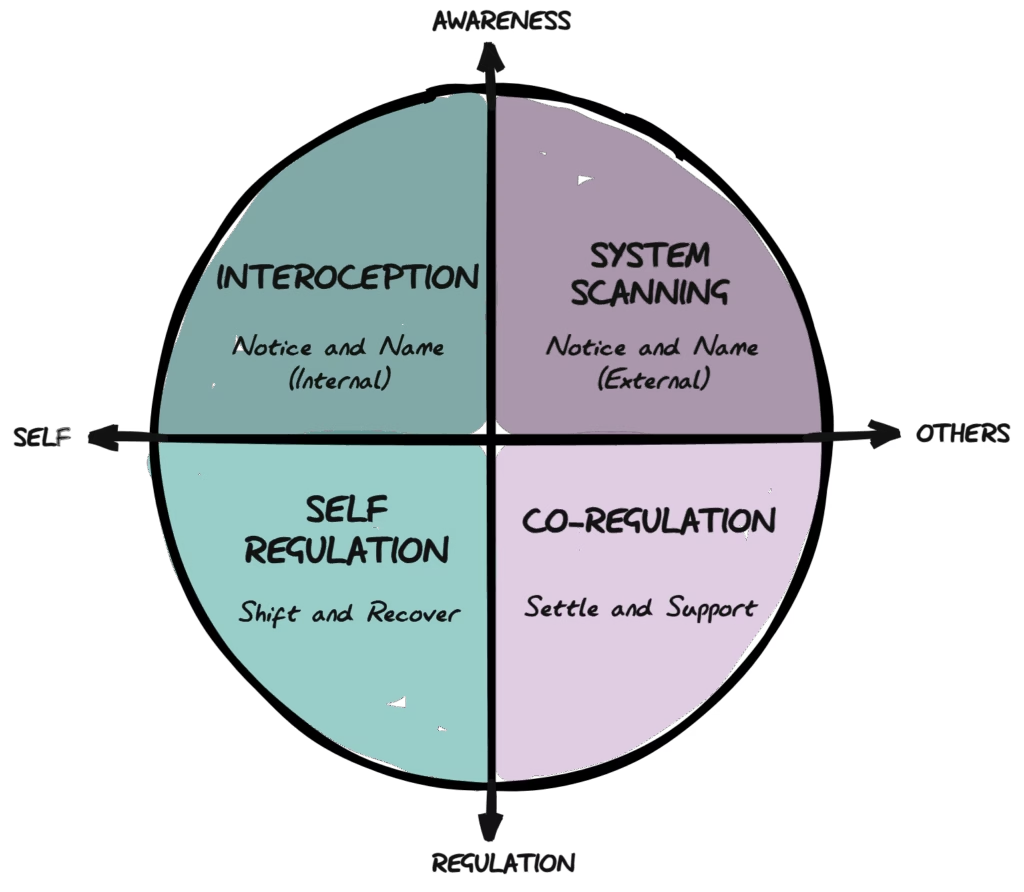
This is why I’ve developed the Nervous System Compass™ – a practical framework for building what I call nervous system intelligence in leaders and organisations.
What is Nervous System Intelligence?
Nervous system intelligence is the capacity to work with your autonomic nervous system rather than being hijacked by it. It’s the difference between reacting to stress and responding to it. Between shutting down in conflict and staying present through discomfort. Between leading from a state of chronic activation and leading from a place of grounded clarity.
It is about your ability to:
- Notice what’s happening in your body and nervous system and make sense of those signals in context.
- Shift and recover your state when you need to.
- Read and respond to the nervous systems of the people around you.
- Shape an environment where more people can stay in their “window of tolerance” – able to think, connect and perform.
Instead of asking, “How do I stay calm all the time?” we ask, “How do I work with an activated nervous system, stress, threat and shutdown – in myself, in my team, and in the wider system?”
This is especially relevant for leaders in today’s workplaces, where pace, ambiguity and complexity are at an all time high, chronic stress and burnout are endemic and inclusion is expected, but many systems still feel unsafe, particularly for under-represented groups.
When we ignore the nervous system, we end up trying to solve biological realities with more strategy decks and stricter performance frameworks. Unsurprisingly, that doesn’t work for long.
While some approaches are now referencing nervous system awareness, the Nervous System Compass™ is distinct in that it integrates insights from our work with developmental trauma, leadership practice, and diversity, equity, and inclusion (DEI) into one coherent model.
The Four Quadrants of the Compass
The Nervous System Compass™ organises nervous system intelligence into four core capacities, mapped across two dimensions: awareness to regulation, and self to others. It’s structure has echoes of emotional intelligence models, but encourages individuals to operate at a much deeper level and access the intelligence of their body, not just their mind.
Think of it as a compass you can use in any moment of pressure:
- What’s happening in me?
- How can I shift state to something that is more helpful?
- What’s happening around me?
- How can I help people in the system settle so we can do great work together?
1. Interoception: Notice and Name (Internal)
This is your ability to detect and interpret the signals your body is constantly sending you – heart rate, breath, tension, body sensations – and assign meaning to them that’s contextually appropriate rather than reactive.
In practice, this can look like:
- Recognising the tightness in your chest during a budget meeting and naming it as “arousal from uncertainty” rather than automatically assuming threat
- Distinguishing between actual danger signals and low blood sugar
- Noticing your nervous system is getting activated, and pausing before making a snap decision
Most leaders operate with remarkably low interoceptive literacy. They’ve learned to override their body’s signals in service of productivity, only to find those signals show up as irritability, burnout, or poor judgment.
2. Self-Regulation: Shift and Recover
Once you can read your internal state, the next capacity is learning to shift and stabilise your state so that it helps rather than hinders, and figuring out how to recover efficiently after stress.
In practice, this may look like:
- Using a breathing technique before a difficult conversation to move from agitation to groundedness
- Knowing when you need creative, expansive energy versus focused, disciplined energy – and having the tools to shift between them
- Shortening your recovery time after setbacks so you’re not carrying the residue of one meeting into the next
Self-regulation isn’t about staying calm all the time. It’s about state flexibility – having access to the full range of your nervous system’s responses and choosing the one that serves you. To achieve this state flexibility we can’t just focus on our reactions in the moment – we also need to take a longer-term more strategic approach – consistent practice of nervous system regulation activities improves our regulatory capacity over time. Think of it as attending the gym to build muscle so your body can stay fit and strong and healthy, but in this case it’s exercise for the nervous system so that you can deal more effectively with stress over the long term.
3. System Scanning: Notice and Name (External)
Your nervous system is constantly scanning other people’s nervous systems. You pick up on vocal tone, facial tension, breathing pace, posture shifts – often unconsciously. System scanning is about making this process conscious and accurate.
In practice, this can look like:
- Noticing clipped answers in a team member and wondering aloud whether the pace of change is too fast, rather than assuming resistance
- Reading fidgeting or micro-pauses as possible signs of cognitive load or social threat, not lack of preparation
- Checking your hypotheses about what you’re observing rather than jumping to conclusions
The key is seeking attribution clarity: treating your observations as data that needs testing, not truth. Especially in diverse teams, our unconscious scanning can be filtered through bias. Developing this capacity means building in humility and context-checking. Think of it as perspective getting rather than perspective taking.
4. Co-Regulation: Settle and Support
This is where nervous system intelligence becomes a leadership superpower. Co-regulation is your ability to intentionally shape the nervous system environment for others – to widen their window of tolerance – through how you show up.
In practice, this may look like:
- Opening tough meetings with a 60-second orienting speech that signals safety: clear purpose, transparent process, permission to pause
- Using vocal cadence and strategic pauses to slow the room when nervous system activation is spiking
- Protecting breaks, managing pace, and creating predictability through rituals and norms
- Swift repair after moments of strain
Co-regulation doesn’t mean being “nice” or soft. It means being attuned. A leader who can co-regulate effectively can hold difficult conversations, deliver hard feedback, and push for high standards while keeping people’s nervous systems within a workable range.
Why This Matters Now
The demands on leaders have never been higher. Remote and hybrid work has removed many of our in-person nervous system cues. Chronic uncertainty has kept activation levels elevated for years. Burnout isn’t an individual failing – it’s chronic nervous system activation at scale.
Traditional leadership development often assumes that people have equal access to their cognitive resources at all times. But neuroscience shows us this simply isn’t true. When your nervous system perceives threat – whether from an impossible deadline, an ambiguous email from your boss, or a pattern of microaggressions – your capacity for language, creativity, perspective-taking, and strategic thinking narrows.
Nervous system intelligence gives you the tools to notice when you’ve left your window of tolerance, to shift back into it, and to create conditions where your team can do the same.
Where to Start
Developing nervous system intelligence isn’t about adding more to your plate. It’s about bringing awareness to what’s already happening beneath the surface.
Start with interoception. Take 90 seconds before your next high-stakes meeting to notice: What sensations in my body am I aware of right now? Where is there tension or ease? What might my body be signalling about what I need?
That’s it. Just notice and name.
And if you want to develop your self regulation capacity, why not download our Nervous System Toolkit which is a collection of practices and techniques has been designed to help you understand and manage your body’s response to stress, anxiety, and overwhelm.
The Nervous System Compass™ isn’t about perfect regulation or never being stressed. It’s about developing the capacity to work skilfully with your nervous system – and to help others do the same.
Because the most powerful leadership tool you have isn’t your strategy or your charisma. It’s your presence. And presence is, fundamentally, a nervous system state.
This article is intended as an introduction to Nervous System Intelligence and the Nervous System Compass – we will continue to share our thoughts and practical techniques to develop your Nervous System Intelligence. If you want to know more, sign up to our newsletter where you will be the first to hear of additional articles and resources as they are published.